










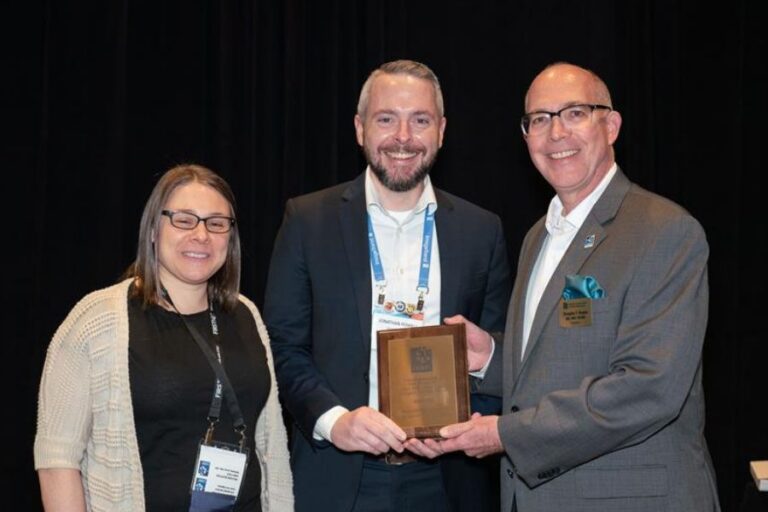
At the National Association of EMS Physicians (NAEMSP) 2026 Annual Meeting, ImageTrend Epidemiologist Jonathan Powell, PhD, NRP, was honored with the Best EMS Professional Research Presentation award. The annual meeting, held January 26–31, 2026, brings together EMS physicians, researchers, and clinical leaders to share research shaping the future of prehospital medicine.
Jonathan’s award-winning presentation, Race and Ethnicity Concordance Between EMS Clinician and Patient Is Associated with Higher Delivery of Analgesic Medications, takes on a complicated question in EMS: what do we know about disparities in patient care, and what can the data actually tell us?
Why This Research Matters
Multiple studies have shown differences in EMS care delivery based on patient race and ethnicity, particularly when it comes to administering pain medication. These studies often suggest clinician bias as a potential explanation, but most lack clinician-level demographic data to establish that link, making it difficult to understand what’s actually associated with these differences.
“We’re still observing differences in care based on race and ethnicity, and while biases may be present, the data isn’t there yet to make those definitive assumptions,” Jonathan said. “Something is happening here—and these differences shouldn’t be present; we need to investigate them responsibly with evidence-based methods while acknowledging current limitations.”
Connecting Patient and Clinician Data, Without Assigning Blame
What makes this research unique is its ability to examine patient care alongside care team demographic characteristics. Using ImageTrend Collaborate and License Management, the study combined de-identified patient care documentation with clinician licensure records, two datasets that are typically separate in EMS research.
This approach allowed the research team to explore whether race or ethnicity concordance (when a patient shares a race or ethnicity with at least one member of their care team) was associated with differences in care delivery. These results will be submitted for peer review and scholarly publication. Presenting at this meeting was the first step in a long but necessary process to increase transparency and credibility.
What the Study Found, and Its Limits
The analysis focused on patients with EMS-identified long-bone trauma (injuries involving major bones such as the femur, tibia, humerus, or radius) across three participating states that collect sufficient race and ethnicity data for both clinicians and patients.
Key findings included:
- Non-white or Hispanic patients were less likely to receive pain medication compared to white, non-Hispanic patients.
- This pattern was present across care teams, including all-white teams and teams with at least one non-white or Hispanic clinician.
- When a patient shared race or ethnicity with at least one member of the care team, the likelihood of receiving analgesic medication was higher.
The study is exploratory by design. Only a limited number of states currently collect clinician race and ethnicity data with enough completeness, and the findings do not establish causation.
“It may indicate bias,” Jonathan said, “but we can’t definitively show that with the data as it exists today. Concordance could be a proxy for shared experiences or how people navigate the world, but we’re careful not to draw conclusions the data can’t support.”
Moving the Conversation Forward
For Jonathan, the goal of this research is to encourage awareness, transparency, and better data collection to enable future work in this space.
“What we’re committed to is improving how patient and clinician characteristics are documented, so we know what is really happening on the ground,” he said. “We need to be transparent about the limitations of current research methods and focus on supporting patient-centered, evidence-based care that shouldn’t vary based on things patients aren’t in control of.”
He also emphasized the importance of education. “Clinicians need to know that these differences in care exist. That awareness is a first step toward ensuring care is guided by evidence and applied consistently.”
More on These Trends: 2025 EMS Insights Report
For readers interested in a broader look at national EMS trends, including sections that explore differences in care such as pain management, ImageTrend’s 2025 EMS Insights Report provides additional context using the ImageTrend Collaborate dataset.
Built on more than 11.3 million EMS activations, this report offers a national view of the trends shaping prehospital care, helping EMS leaders benchmark performance, understand demand, and support evidence-based decision-making.
About ImageTrend Collaborate
ImageTrend Collaborate is a national research initiative powered by de-identified EMS data. Researchers and public health experts use this growing dataset to uncover trends, inform policy, and explore collaborative projects that drive meaningful change across EMS and public health.

Teagan Fast
Optional Pre-Title H3 – Basic Content on White
Paragraph Text – Lorem ipsum dolor sit amet, consectetur adipiscing elit, sed do eiusmod tempor incididunt ut labore et dolore magna aliqua. Ut enim ad minim veniam, quis nostrud exercitation ullamco laboris nisi ut aliquip ex ea commodo consequat.