










EMS work is complex, fastmoving, and shaped by pressures that don’t always match common assumptions. Let’s explore some of the most persistent myths about emergency services and the realities EMS crews navigate every shift.
Myth #1: EMS crews wait at the station for calls
Reality: Most crews are already on the move when calls come in. In busy systems, EMS providers often run back-to-back calls for entire shifts, covering large service areas.
Why it matters:
Providers are expected to deliver focused, compassionate care even after handling multiple calls earlier in the day.
Myth #2: Most EMS calls are major emergencies
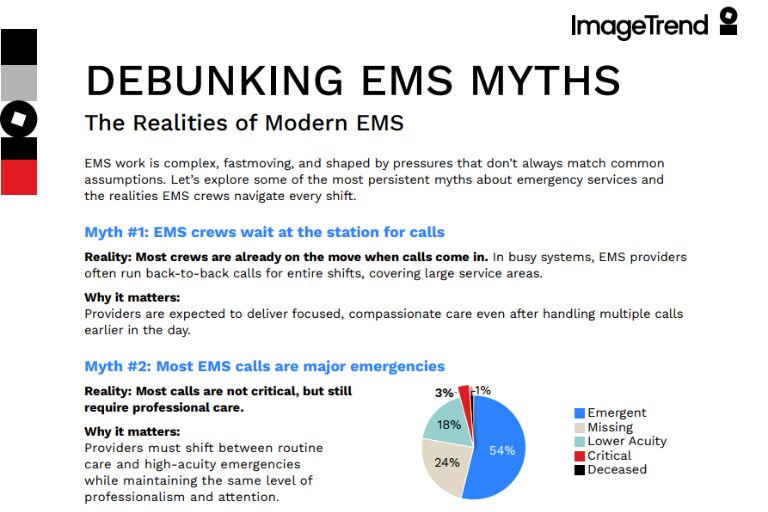
Reality: Most calls are not critical, but still require professional care. Initial patient acuity data shows 18% of calls are low–acuity, 54% are emergent, and only 3% are classified as critical.
Based on initial patient acuity data from ImageTrend’s 2025 EMS Insights Report.
Why it matters:
Providers must shift between routine care and high-acuity emergencies while maintaining the same level of professionalism and attention.
Myth #3: Staffing shortages only affect scheduling
Reality: Staffing shortages increase burnout and operational risk.
Operational impact:
- Longer shifts with less downtime for recovery
- Documentation completed after hours
- Higher turnover and loss of experience
- Compounded fatigue over time
Myth #4: EMS providers are primarily ambulance drivers
Reality: EMS providers are healthcare professionals delivering care before the hospital. Crews assess patients, administer medications, and stabilize conditions (in some cases, without transport to the hospital).
Key takeaway:
EMS delivers healthcare, not just transportation.
Myth #5: EMS is well funded because it’s part of public safety
Reality: Many EMS systems are underfunded and not legally designated as public safety services. Agencies often rely on reimbursement, local funding, or grants to stay afloat.
Why funding matters:
Underfunding contributes directly to burnout and turnover while limiting investment in staffing, wellness, training, and technology.
Myth #6: EMS documentation happens in real time
Reality: Documentation often happens after patient care is complete.
Common challenges:
- High call volumes
- Limited time for documentation
- Complex interfaces
- Repetitive clicks that reduce accuracy
Myth #7: Crews resist technology because they dislike change
Reality: Crews resist tools that don’t improve daily workflows.
What supports adoption:
- Tools that reduce documentation time
- Clear performance visibility and valuable insights
- Tools that work the way EMS works
The Takeaway
The biggest myth is that these challenges are unavoidable.
When software is built for real EMS workflows, agencies can reduce documentation burden, use data more confidently, and give providers more time to focus on patient care.
Learn how ImageTrend Elite supports the realities of modern EMS.