









 The Challenge
As the sole ALS provider across Kings County, Fresno County, and Madera County, American Ambulance operates at significant scale. With approximately 150 ambulances in service each day and around 200,000 transports annually, crews are responsible for a high volume of complex patient care and documentation.
In this environment, maintaining efficient and accurate documentation is critical, with narrative writing often taking the most time to complete. “The narrative is really the longest time piece…because you’re sitting there typing it out,” explained CQI/CQA Coordinator Scott Charlston, who oversees the organization’s ImageTrend environment and supports multiple agencies.
Crews often had to manually type detailed patient narratives, revisiting sections to correct spelling, add missing details, or rework phrasing. These steps slowed report completion and added friction to an already demanding workflow, especially during high call volumes or long shifts. At the same time, maintaining consistency and completeness across documentation fields like treatment entries required careful review, as well as follow-up from QA and leadership teams.
These pressures created a growing need for a faster, more efficient way to document patient care without compromising quality.
The Solution
To address these challenges, American Ambulance began implementing AI Assist to support documentation workflows within ImageTrend.
Rather than rolling it out broadly all at once, Charlston and his team took a phased approach. The initial rollout focused on a select group of high-performing documenters, including supervisors, field training officers, and critical care team members. “That gave us a chance to gather feedback and build training before rolling it out more widely,” Charlston said.
From there, the organization developed structured training and incorporated it into its quarterly continuing education (CE) process, ensuring all crews had exposure to the tool and guidance on how to use it effectively.
AI Assist quickly became most valuable in two key areas:
- Narrative documentation through speech-to-text dictation
- Image capture to scan face sheets, medications, and other patient information
Crews primarily used AI Assist to dictate narratives, allowing them to capture patient stories more naturally while reducing manual typing. “Having that be able to dictate and have good grammar…is really the biggest piece for us,” Charlston said.
Together, these capabilities helped reduce one of the most time-intensive parts of documentation, allowing crews to complete reports more efficiently while maintaining the level of detail required.
The Outcome
Since implementing AI Assist, American Ambulance has seen several measurable and observed improvements across their documentation workflows:
- Faster narrative completion: Crews can complete narratives more quickly using dictation, reducing one of the most time-intensive parts of the PCR
- More detailed documentation: Narratives generated with AI Assist tend to be longer and more complete compared to manually typed reports
- Improved data capture: Increased use of scanning contributes to capturing additional details, such as health insurance policy numbers from face sheets
- Better treatment documentation: More treatments are being properly documented in structured fields rather than only in the narrative, reducing the need for QA follow-up
- Strong crew adoption: Crews consistently point to dictation and image capture as standout features, and the tool has quickly become a valued part of the documentation workflow.
To evaluate the impact, the ImageTrend Research Team analyzed documentation trends before and after AI Assist was fully implemented. One measurable example of improved data capture is the increase in the percentage of transported patients with a documented health insurance Policy ID over time.
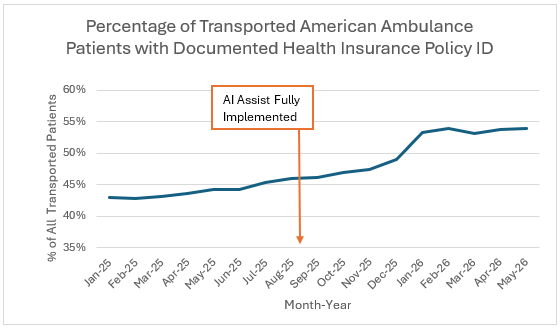
That rate rose from about 43% to about 54%, with a noticeable increase after AI Assist was fully implemented in September 2025. More consistent capture of policy ID information can help support reimbursement by reducing the need for billing staff to track down missing insurance details later.
Adopting AI: From Rollout to Routine
While not every improvement is easily captured in a single metric, the shift in how crews approach documentation has been clear. As AI Assist became more widely used across the team, narrative writing moved from a manual, time-intensive task to a more natural part of the workflow, allowing crews to complete reports with less interruption.
Today, AI-driven documentation has become an expected part of the process. In fact, crews tend to notice it most on the rare occasions when it’s unavailable. “We had an internet downtime a couple of days ago, and the crews were like, ‘man, I had to manually complete my PCR,’” Charlston said. “That’s when you really see the difference.”