










Originally published December 2025. Updated February 2026 to include new AI Assist usage findings.
Emergency response teams are under more pressure than ever with higher call volumes, staffing challenges, and the ongoing expectation to complete accurate, timely documentation. Over the past year, AI Assist has emerged as one of the most impactful tools in easing that workload, and recent usage patterns show that momentum is growing across EMS agencies of all sizes.
AI Assist wasn’t created as a distant vision for the future. It’s a working, real-world capability designed to reduce manual data entry, improve accuracy, and simplify day-to-day workflows. With standout AI documentation features, there has never been a better time for agencies to understand what AI Assist can do and how simple it is to activate.
Adoption is Growing: What the Numbers Show
In the last 90 days, AI Assist use has continued to climb as more teams discover how much time they can save by relying on automation for structured data entry.
Across all participating agencies:
- 2.2M+ fields have been applied using AI Assist
- More than 77,000 image analyses were completed
- AI Assist was leveraged 159,000 times to populate reports
- More than 1,900 agencies have leveraged AI Assist
- 71,000+ transcriptions occurred using voice-to-text
- Tens of thousands of approvals and rejections demonstrate active human review
This level of engagement tells an important story: AI Assist is not a niche feature; it’s becoming a core part of documentation workflows. And yet, many agencies still don’t know that AI Assist is included in Elite at no additional cost and can be turned on instantly.
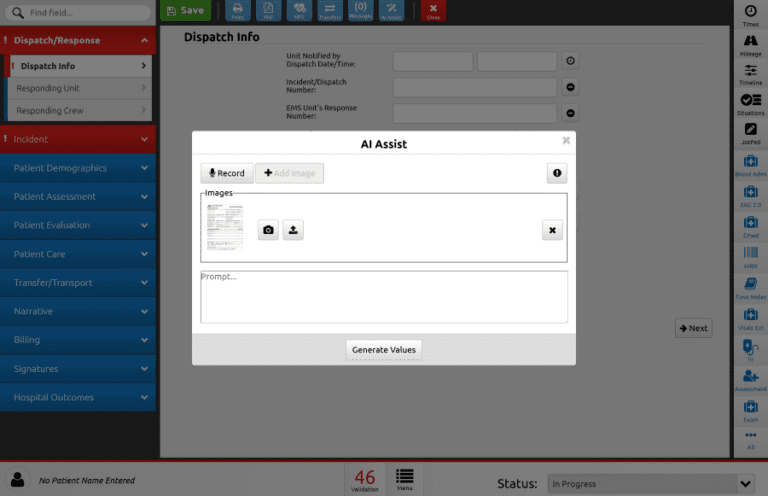
One of the Biggest Benefits: Image Capture + OCR
The most consistently praised capability of AI Assist is its image recognition and OCR (optical character recognition), and for good reason.
Capturing information directly from:
- Driver’s licenses
- Medication lists
- Handwritten notes
- Pill bottles
- Face sheets and facility paperwork
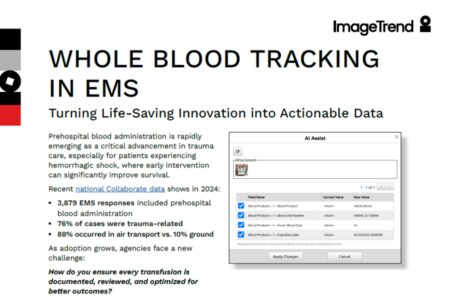
- Blood product labels
This allows providers to fill out large portions of the patient care report without typing. This is especially useful during interfacility transports, as well as emergent and non-emergent responses, where complex information must be transcribed quickly and accurately.
Instead of manually entering a patient’s name, date of birth, address, medications, allergies, or provider information, AI Assist extracts and applies this data for review in seconds. For many agencies, this has become the workflow that saves them the most time per report.
Providers still retain full control—every suggested data point must be approved. But the hours saved across a shift, day, or week are substantial.
Voice-to-Text Designed for EMS
General-purpose dictation tools often fall short in emergency medicine. AI Assist’s voice engine is tailored to understand EMS terminology and shorthand so that providers can dictate assessments, vitals, procedures, and narratives in plain language.
It recognizes common clinical phrasing such as:
- “A&O x4”
- “18 gauge in the left AC”
- “SPO2 99 on room air”
- “IV established”
- “Sinus tach at 12”
These values map directly into structured report fields, reducing the need for repetitive clicking and navigation. For providers juggling multiple tasks at once, or wearing gloves while documenting mid-transport, this capability removes friction from the documentation process.
AI Assist Incident List Search
AI Assist is not limited to point-of-care documentation. The Incident List search feature is a useful tool for administrators, CQI teams, and clinical supervisors who need quick access to specific incident types.
Instead of building complex filters, users can type simple keywords such as:
- “traumatic injuries this month”
- “respiratory complaints last week”
- “refusals with vitals missing”
- “cardiac arrests involving CPR”
The system surfaces matching incidents based on keyword relevance, which makes trend analysis, QA review, and data auditing significantly faster and more intuitive.
For teams looking to strengthen QA/QI processes or speed up administrative workflows, turning on the Incident List AI search can make an immediate difference.
It Takes Seconds to Turn On
AI Assist is quick and simple to enable. Administrators only need to adjust the permission settings for their agency, and access is granted instantly for everyone in that permission group.
Administrators can turn on AI Assist with just a few clicks:
- Open your Permission Group
- Search “AI Assist” in permission objects
- Toggle to “Yes”
That’s it. Anyone in that permission group instantly gains access.
This same process applies to:
- AI Assist for EMS
- AI Assist Incident List search
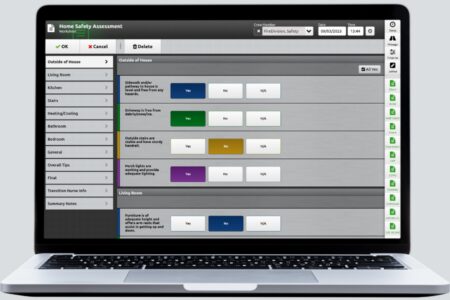
- AI Assist for Community Health visits
Data Security You Can Trust: AI That Stays in Your Environment
Trust and safety are core components of ImageTrend’s AI strategy. AI Assist was intentionally built on a foundation of responsible, secure, and transparent practices, ensuring providers can use AI tools confidently.
Key Protections
- No PHI or PII ever leaves ImageTrend’s hosting environment.
- Data is never shared with public or third-party AI models.
- Voice recordings, images, and extracted text are deleted after processing.
- Systems adhere to HIPAA and SOC-2 standards.
- AI Assist operates entirely within ImageTrend’s secure Azure infrastructure.
- Providers must approve all suggestions—AI never auto-enters data.
This human-in-the-loop (HITL) design ensures agencies retain full control over documentation, maintain accuracy, and meet local privacy or security requirements.
See AI Assist in Action
This short video shows how AI Assist uses voice, images, and human-in-the-loop review to turn real-world EMS and Fire documentation into structured data—without sacrificing control or security.
The Future is Here and Easy to Access
AI Assist is helping providers work faster, improve accuracy, and focus more attention on patient care rather than data entry. Whether an agency wants to reduce documentation time, streamline interfacility transports, or strengthen NEMSIS reporting, AI Assist can make an immediate impact.
Since AI Assist is already included in Elite, the next step is simply turning it on.
Ready to start documenting faster and smarter? Chat with our team of experts to learn more.

Teagan Fast
Optional Pre-Title H3 – Basic Content on White
Paragraph Text – Lorem ipsum dolor sit amet, consectetur adipiscing elit, sed do eiusmod tempor incididunt ut labore et dolore magna aliqua. Ut enim ad minim veniam, quis nostrud exercitation ullamco laboris nisi ut aliquip ex ea commodo consequat.