










Fire and EMS agencies have always been viewed as responders first.
They arrive on scene, assess patients, provide care, and transport them to the nearest appropriate facility. From a hospital perspective, that is often where the relationship ends.
But that view is incomplete—and increasingly outdated.
Across the United States, EMS is responsible for a significant portion of emergency department volume. In many communities, EMS represents one of the largest and most consistent sources of patient inflow. These aren’t just routine visits, either. Many EMS-transported patients fall into high-acuity categories such as trauma, stroke, cardiac emergencies, and sepsis; conditions that require immediate intervention and have a significant impact on clinical outcomes, operational performance, and hospital revenue.
In other words, EMS isn’t just transport. It’s one of the most influential referral networks in healthcare.
What are EMS Referral Patterns?
EMS referral patterns describe how patients move from emergency medical services into hospitals, including:
- Which hospitals receive patients
- Which EMS agencies transport to specific facilities
- Where patients originate geographically
- How destination decisions affect patient flow and hospital market share
While hospitals closely monitor admissions, transfers, and service-line performance, many have limited visibility into the EMS activity driving those numbers.
Understanding EMS referral patterns provides a more complete picture of how patients enter the healthcare system, and why they choose one destination over another.
Why Hospitals Have Limited Visibility into EMS Referral Patterns
Most hospitals have little visibility into what happens before a patient arrives.
They often cannot see:
- The patient’s initial presentation
- Treatments performed in the field
- EMS destination decision-making
- Trends occurring across EMS agencies in their region
At the same time, EMS agencies frequently have limited insight into what happens after handoff.
They may not know:
- Whether interventions improved outcomes
- What diagnosis was ultimately assigned
- How the patient progressed after arrival
- What could be improved during future responses
This disconnect creates more than a data gap—it creates an operational and strategic blind spot.
Without a complete view of the patient journey, both hospitals and EMS agencies are making decisions using only part of the story.
How EMS Referral Decisions Influence Hospital Growth and Patient Volume
In many markets, hospitals compete for the same patients.
While destination decisions are often guided by protocols, specialty capabilities, and patient needs, hospitals that build strong relationships with EMS agencies frequently gain important advantages.
Factors influencing EMS destination decisions may include:
- Efficiency of patient handoff
- Access to specialty services
- Historical working relationships
- Availability of patient outcome data
- Overall ease of collaboration
This matters because EMS patients frequently represent some of the most clinically complex and financially significant cases entering the healthcare system.
When hospitals lack visibility into referral patterns, they may miss opportunities to:
- Strengthen EMS partnerships
- Improve patient flow
- Identify service-line growth opportunities
- Reduce patient leakage to competing facilities
Understanding EMS Referral Patterns Requires More Than Hospital Data
Many hospitals can tell you how many patients arrived at the emergency department yesterday.
Far fewer can explain why those patients arrived at their facility instead of another hospital across town.
Questions such as:
- Which EMS agencies bring the highest volume of patients?
- Which ZIP codes generate the most referrals?
- Where are high-acuity patients going?
- Which service lines are gaining or losing market share?
- When do patient offload delays occur most frequently?
This is where Hospital Market Intelligence becomes valuable.
Built on biospatial by ImageTrend, Hospital Market Intelligence provides near real-time insight into EMS transport activity, referral patterns, patient flow, and market dynamics that can help healthcare organizations make more informed operational and strategic decisions. Rather than relying solely on retrospective hospital data, leaders can identify emerging trends as they happen, uncover referral opportunities, evaluate patient leakage, and better understand the factors influencing hospital market share.
Examples include:
- Visualizing EMS market share by geography or service line
- Identifying referral sources and transport patterns
- Monitoring patient offload times and throughput challenges
- Evaluating interfacility transfer activity
- Understanding demographic and geographic trends affecting growth
These insights help hospitals move beyond simply measuring performance and begin understanding what is driving it.
Why EMS-Hospital Interoperability Matters
Understanding referral patterns is only one piece of the equation.
Hospitals also need access to the clinical information that exists before a patient arrives. Unfortunately, many organizations still rely on fragmented workflows, manual follow-up, and disconnected systems to obtain EMS information. This creates unnecessary delays, duplicate work, and incomplete patient records.
Modern EMS-hospital interoperability helps solve these challenges by connecting prehospital and hospital data into a more complete episode of care.
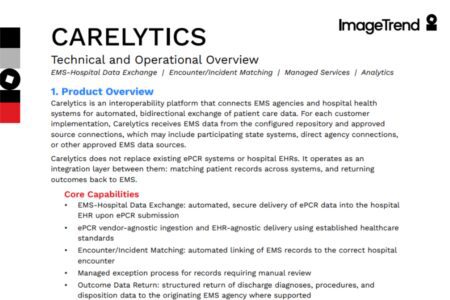
Solutions like Carelytics help hospitals:
- Receive EMS records electronically and automatically
- Match EMS reports to the correct hospital encounter
- Reduce manual reconciliation and follow-up
- Exchange outcome information back to EMS agencies
- Improve continuity of care across settings
By creating a stronger connection between EMS and hospital systems, organizations gain a more accurate understanding of patient flow, referral dynamics, clinical outcomes, and operational performance.
Most importantly, they begin closing the loop between what happens before arrival and what happens after admission.
From Referral Patterns to Strategic Action
The value of EMS data extends far beyond documentation.
When hospitals can see referral patterns, patient movement, and market dynamics more clearly, they can make more informed decisions about:
- Emergency department operations
- Capacity planning
- Service-line growth
- Community outreach
- EMS partnership development
- Quality improvement initiatives
In one example, a large health system used EMS transport and referral data to identify high-acuity patient leakage to competing facilities. After analyzing those patterns, the organization relocated a medical helicopter, resulting in a 650% single-month impact and 76% year-over-year flight growth.
That kind of visibility simply isn’t possible when EMS data remains disconnected from hospital decision-making.
The Future of Hospital Growth Starts Before the Patient Arrives
Hospitals can no longer afford to view EMS as simply a transportation service.
EMS agencies generate critical clinical information, influence destination decisions, and provide one of the earliest indicators of shifts in patient demand. Organizations that understand and act on EMS referral patterns will be better positioned to improve patient flow, strengthen care coordination, identify growth opportunities, and deliver better outcomes.
Because EMS was never just transport. It was always one of healthcare’s most important referral networks.
Interested in gaining greater visibility into EMS referral patterns, patient flow, market share, and interoperability opportunities? Chat with an expert today to learn more.