











In EMS, ePCR software is rarely used under ideal conditions. Crews may document in a moving apparatus, at the roadside, in a crowded emergency department or at the end of a long shift. Another call may already be waiting.
Even motivated, experienced crews can struggle when new documentation software changes a well-established routine. A familiar clinical workflow has suddenly become unfamiliar.
When crews take longer to complete reports or ask to return to an old workflow, it is easy to call the response “resistance to change.” But the crew experience is shaped by more than the software alone. Configuration, integrations, user acceptance testing, training, and post-go-live refinement all affect how quickly a new ePCR becomes part of routine field work.
The learning curve and cognitive load in EMS documentation
Cognitive load is the mental effort needed to process information and complete a task. In EMS, providers already use that capacity to assess patients, weigh clinical possibilities, provide treatment and then reconstruct a sequence of events when finalizing documentation.
A 2025 systematic review of cognitive load in paramedical settings found high-certainty evidence that poorly designed or difficult-to-use equipment and operational complexity were associated with higher cognitive load. Streamlined procedures, prepared equipment, and training were associated with lower load.1
The review was not specific to ePCR implementation, but it does offer a useful way to examine documentation: unnecessary searching, recall, switching, and duplicate entry add work during an already demanding task.
Some increase in workload is expected when a new ePCR system goes live. A study of 37,599 ambulance calls found that call duration increased during the first three months after electronic patient reporting was introduced but not over the longer term.2 Similarly, a hospital study found that nurses adapted to a new electronic health record at different rates.3
Time and practice may resolve unfamiliarity, but they will not necessarily resolve a workflow that needs further configuration, integration or support.
How configuration can simplify crew workflows
Configuration can be used to simplify the crew experience, giving agencies control over fields, validations, terminology, and workflow steps. A thoughtful, focused build can reduce duplicate work and keep the crew-facing workflow centered on the information providers need at each point in the documentation process.
During configuration, the agency decides how much of its existing process to retain, change or automate. The aim is not to activate every available option, but to support and streamline clinical, operational and reporting needs with as little unnecessary work as possible.
During configuration and testing, agencies can ask:
- Does this field support patient care, reporting, quality improvement, billing or another defined need?
- Can a provider find and complete the requirement at that point in a realistic call?
- Does a validation prevent a meaningful error, or does it simply interrupt completion?
- Is the same information already available from CAD, staffing or another connected system?
EMS studies have identified interface limitations, integration problems, and limited internal technical capacity as barriers to ePCR adoption. They also found that internal expertise, flexibility, and prompt responses to feedback can support adoption.4,5
Field providers can offer valuable insight during discovery and user acceptance testing. An experienced EMT or paramedic may notice that a required value is not known until hospital handoff, a choice does not match field terminology or a workflow requires the same section to be opened several times.
An ImageTrend implementation specialist guides the agency through configuration, testing, knowledge transfer and go-live, helping the internal team shape its workflows without managing the transition alone. The experience of West Sacramento Fire shows what that can look like in practice. The department prioritized field data sharing, worked through regular implementation sessions, and trained personnel across shifts. CAD and staffing integrations then allowed incident and crew information to populate reports automatically, so providers did not have to re-enter it.
EMS software training for field use
A software demonstration can show an EMT or paramedic where a feature or field is located, but it does not show them how they will use the system during a call, finish a report between calls, correct an entry, work through an unfamiliar workflow or find help when questions arise.
One national EMS survey offers some insight into ePCR usability and the value of direct practice. Among 3,160 EMS practitioners using a variety of ePCR systems, respondents who received no ePCR training reported an average usability score of 3.7 out of 7, compared with 4.66 among those who received interactive training.6
The 2017 survey was not peer reviewed, but its results favor training that lets providers work directly in the software.
Training can include the work crews will perform. Providers can practice how to:
- Complete routine and complex patient care reports
- Correct an error or respond to a returned report
- Work through required fields when information is incomplete
- Use offline workflows and import or attach information
- Review and submit a report
Training can also be tailored by role. A field provider, CQI reviewer, billing specialist, and system administrator use the same record for different purposes. Covering every function with every user can distract from the workflows each role uses most.
In a train-the-trainer model, internal super-users carry product knowledge into agency workflows. They can reinforce training across shifts, support new hires, and identify recurring confusion, but agencies may need to set aside time for that work.
Introducing AI-assisted documentation
AI-assisted detail capture shows how a helpful ePCR feature can still change a familiar workflow. The goal is more accurate and efficient documentation over time, but crews first need to learn where the feature fits into the reporting process.
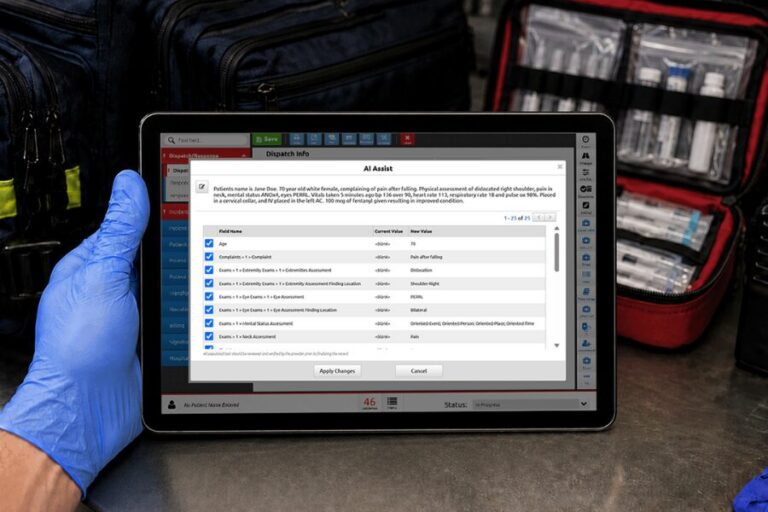
ImageTrend AI Assist: Document Capture can help reduce manual entry by turning voice and images into suggested structured data, including narratives. Providers review suggested information before it is applied, making that review part of the documentation workflow.
Agencies introducing AI-assisted documentation can give crews a chance to practice:
- When dictation or image capture fits the situation
- Which information still requires manual entry
- How to review captured information efficiently
- What to do when a suggestion is incomplete or incorrect
- How agency documentation expectations apply to AI-assisted input
American Ambulance used a phased approach when adding AI Assist to an established ePCR workflow. Experienced documenters, supervisors, field training officers, and critical care personnel provided feedback that helped shape training before broader use. Education then continued through the agency’s quarterly continuing education process.
Agencies implementing a new ePCR system and AI Assist together can include the same review and correction practice in end-user ePCR training rather than treating the feature as a separate implementation.
Refining workflows after go-live
After go-live, agencies can support ePCR adoption by tracking crew questions, resolving problems, and refining workflows based on field use. Crews gain confidence when the system preserves their work, functions in the environments where they use it, and responds predictably during common tasks.
Real-world use can reveal fields, validations or integrations that deserve another look. Reviewing those patterns helps agencies refine configuration instead of assuming every difficulty is a training problem.
An agency may review:
- Documentation completion time
- Reports returned for correction or repeated validation errors
- Support questions by workflow, role or shift
- Duplicate entry, offline or synchronization problems
- Issues reported, resolved and communicated back to crews
Patterns in report quality and support data can show where more help is needed. Repeated problems for one provider may point to a workflow that has not yet become familiar. The same pattern across several providers may suggest a configuration or training issue instead. These measures should be interpreted in context rather than treated as a proficiency measure.
Super-users give crews an internal point of contact after go-live. They can answer routine questions, help troubleshoot problems, and bring recurring concerns back to administrators. Agencies may need coverage across shifts and protected time for that role. ImageTrend offers both in-person and virtual client education when additional training is needed.
When crews provide feedback, agencies can explain what changed, what remains under review and why certain clinical, reporting or operational requirements must remain. ImageTrend’s implementation model includes a 90-day post-go-live assessment, and this overview of ImageTrend implementation explains how real-world use can reveal where configuration, education, and support need more attention.
What agencies can do to support adoption
Crews may need time to become comfortable with new ePCR software. Agencies can help by examining field workflows during configuration, providing scenario-based practice, making support available across shifts, and revisiting the build after go-live.
When difficulties arise, the agency can ask whether the issue reflects unfamiliarity or a workflow that requires more work than necessary. The answer may point toward more practice, a configuration change, technical support or clearer documentation expectations.
Plan an implementation built around your agency’s workflows and your crews’ needs.
Frequently asked questions
Why can new ePCR software be difficult for crews at first?
Early difficulty may reflect unfamiliarity with a new system, but agencies should also review whether the implementation has changed workload, workflow order, documentation requirements or reliability. Depending on the cause, crews may need additional practice, a configuration change or technical support.
How can configuration make an ePCR easier for crews to use?
Configuration can limit unnecessary fields, align terminology with agency practice, automate information from connected systems and place validations where they prevent meaningful errors. Field input and user acceptance testing help agencies confirm that the configured workflow works under realistic call conditions.
What type of ePCR software training works best?
Available evidence favors hands-on training that lets providers work in the software.6 Internal super-users can reinforce that training across shifts, support new hires and identify recurring problems that may require more education or a configuration change.
How should EMS agencies introduce AI-assisted documentation?
Agencies can include AI-assisted documentation in the same hands-on training used for other ePCR features. Crews can practice when to use dictation or image capture, how to review suggested information and how to correct incomplete or inaccurate results. Because the feature changes a familiar workflow, crews may need time and practice to incorporate it into routine documentation.
References
- Zaphir JS, Murphy KA, MacQuarrie AJ, Stainer MJ. Understanding the role of cognitive load in paramedical contexts: a systematic review. Prehosp Emerg Care. 2025;29(2):101-114.
- Kuisma M, Väyrynen T, Hiltunen T, Porthan K, Aaltonen J. Effect of introduction of electronic patient reporting on the duration of ambulance calls. Am J Emerg Med. 2009;27(8):948-955.
- Colligan L, Potts HWW, Finn CT, Sinkin RA. Cognitive workload changes for nurses transitioning from a legacy system with paper documentation to a commercial electronic health record. Int J Med Inform. 2015;84(7):469-476.
- Landman AB, Lee CH, Sasson C, Van Gelder CM, Curry LA. Prehospital electronic patient care report systems: early experiences from emergency medical services agency leaders. PLoS One. 2012;7(3):e32692.
- Baird S, Boak G. Leading change: introducing an electronic medical record system to a paramedic service. Leadersh Health Serv (Bradf Engl). 2016;29(2):136-150.
- National Association of Emergency Medical Technicians.2017 National Survey on EMS ePCR Usability. Published 2017. Accessed July 30, 2026.