









St. Johns County Fire Rescue Cuts Documentation Burden with AI Assist

A red St. Johns County fire truck marked “12” is parked outside near a road, with a watchtower and palm trees in the background under a blue sky, as part of the county’s new AI-assisted emergency response system.

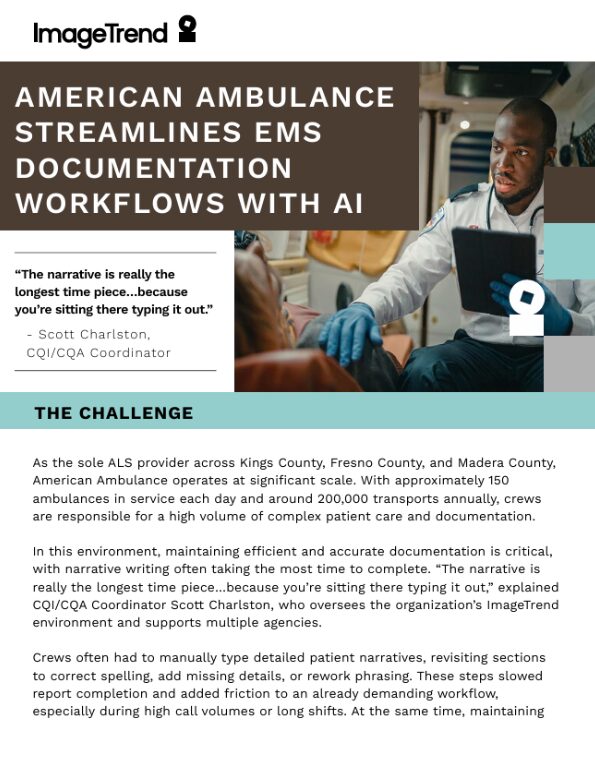
A male emergency medical technician sits in an ambulance at a laptop. Text highlights how AI streamlines EMS documentation workflows for American Ambulance.The Challenge

St. Johns County Fire Rescue oversees EMS operations for a large and growing community in Florida, supporting nearly 500 field personnel responding to approximately 67,000 incidents each year. 

At the same time, documentation continued to place a heavy burden on providers in the field. Crews were often forced to split their attention between patient care and completing detailed reports. 

As Bob Snell, Deputy Chief of Operations (EMS) puts it, “We really want our providers spending their time with the patients and providing great patient care.”  

Manual data entry added another layer of complexity. Errors such as transposed numbers, incomplete insurance details, and inconsistent documentation created downstream challenges for billing, compliance, and quality improvement. 

The agency needed a better way to reduce documentation time, improve accuracy, and support crews without disrupting patient care. 

The Solution

St. Johns County Fire Rescue implemented ImageTrend Elite with AI Assist as a core part of their documentation workflow. AI Assist uses voice recognition, text analysis, and image scanning to capture information and automatically populate patient care reports. 

Key capabilities include: 

  • Voice-to-text documentation for patient assessments and narratives 
  • Image scanning to capture medication lists, insurance cards, and demographic details 
  • Automated data population across multiple report fields 

Together, these capabilities reduce manual entry and simplify one of the most time-consuming parts of documentation. 

The agency positioned AI Assist as more than a feature. It became an essential new foundation for how reports are completed. According to Snell, “It’s not just an added feature… it’s a fundamental recasting of how we write reports.”  

By introducing AI Assist at go-live and embedding it into training, crews adopted this approach from the start, capturing key information like demographics and insurance at the point of care rather than manually entering it later. 
See the Full Story

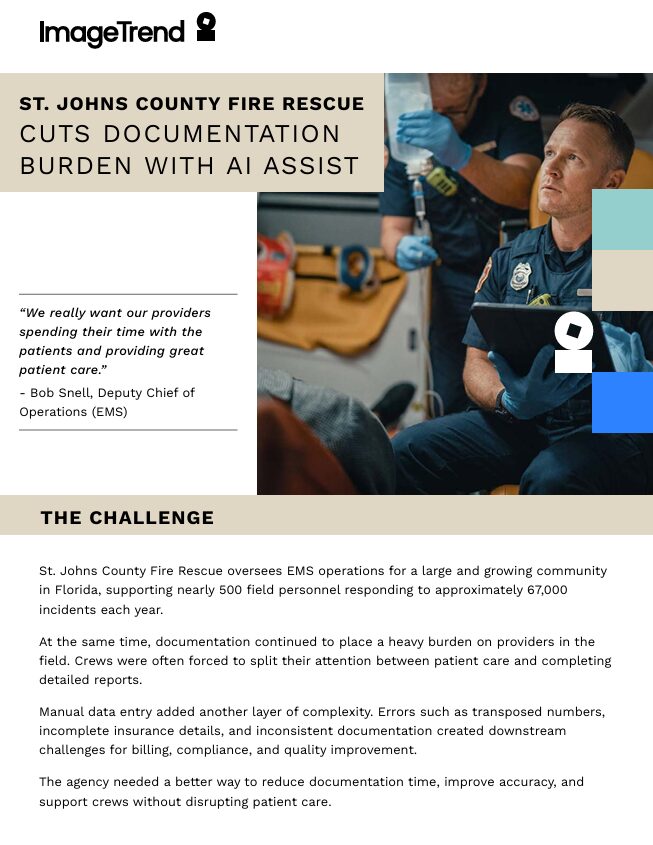
A paramedic listens attentively during a briefing; an on-screen quote highlights the use of AI to reduce EMS documentation burden at St. Johns County Fire Rescue.

Download this PDF

The Outcome

With AI Assist integrated into daily workflows, St. Johns County Fire Rescue quickly saw a shift in how crews approached documentation. Providers were able to capture key information earlier in the encounter—scanning demographics, insurance details, and medication lists at the patient’s side—reducing the need to reconstruct reports later.  

At the same time, crews gained flexibility in how they documented, adapting the technology to their own workflows. As Snell explained, “Each individual rider is going to come up with their own flow… our providers have taken it far beyond what our initial introduction was.”  

Over time, documentation began shifting closer to real time, with more reports being completed earlier in the process, including before leaving the hospital. According to Chief Snell, AI Assist has helped improve report completion time while supporting more accurate and complete reports, reducing time spent on quality improvement review, and speeding up billing processing. 

Most importantly, the technology reduced the need for providers to focus on screens instead of patients. “I’m not seeing that as much at all anymore…” Snell says. “They’re concentrating more on patient care.”  

Adoption has also been nearly universal. AI Assist is used on 85% of all fire and EMS reports. The remaining reports are largely incidents in which a unit was canceled or performed only limited actions. 

The Results

MetricBefore AI AssistAfter AI Assist

Data Capture & Entry 

Providers manually entered demographics, medication lists, insurance details, and other patient information into reports. 

AI Assist automatically populated 472,948 fields, averaging 44.7 fields captured per incident. 

Documentation Workflow 

Information gathered at the patient’s side often had to be re-entered into the PCR later, creating additional documentation steps. 

Providers use AI Assist on 85% of all fire and EMS reports, averaging 2.9 uses per incident and helping move documentation closer to real time. 

Information Collection 

Medications, patient demographics, IDs, and insurance cards were manually reviewed and transcribed into reports. 

AI Assist used to instantly capture medication data, demographics, ID information, and insurance details. 

Documentation Scale 

Every field required manual completion by providers. 

More than 34,000 AI Assist completions have helped populate nearly half a million report fields. 

Provider Confidence 

Manual documentation required extensive data review and entry. 

More than 20,000 completions applied with only 422 rejected completions. 

Operational Impact 

Incomplete or inconsistent reports required more downstream review and processing. 

More accurate and complete reports have reduced QI review time and helped speed up billing processing. 

Looking Ahead

St. Johns County Fire Rescue is continuing to build on this foundation by expanding how AI supports documentation quality and operational insight. With the introduction of AI Assist: CQI Check, the agency is shifting quality assurance from a reactive process to a more proactive one, identifying inconsistencies and missing information before reports are submitted. 

This evolution aligns with a broader goal of applying AI not just to speed up documentation, but to improve it at every stage—supporting crews in capturing accurate, complete information the first time and reducing the need for downstream corrections. As Deputy Chief Snell noted, the opportunity extends across every report: “The ability to improve our documentation across the board.”  

Looking ahead, St. Johns County Fire Rescue sees AI as a key part of creating more consistent documentation, uncovering trends across calls, and strengthening both clinical and operational decision-making. 

Hands typing on a laptop keyboard with digital invoice and interface graphics projected above the keys, symbolizing online invoicing or digital finance management.

Related Resources

Tomorrow Won’t Look Like Today. Prepare for What’s Next.

See the bigger picture and confidently face the challenges ahead with our industry-leading solutions.

Schedule a Demo