










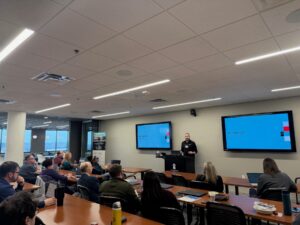

Webinar Description
Emergency Medical Dispatch (EMD) systems utilizing the Medical Priority Dispatch System (MPDS) provide structured protocols to triage 9-1-1 calls and recommend EMS response levels. Dispatch recommendations may not align with realities of complex EMS systems with tiered responses, mixed transport resources, and varying clinician levels. Historically, EMS systems adjust individual MPDS codes in isolation without a comprehensive data-focused evaluation.
Our innovative analytics dashboard within a large metropolitan fire-based EMS system links MPDS determinants to real-world prehospital clinical and operational outcomes. The platform development had barriers and facilitators but integrates procedures performed, patient acuity, high-risk conditions, response intervals, transport patterns, and demographics to allow system-wide evaluation of dispatch performance. This approach enables systems to identify opportunities to adjust response levels, refine ALS and BLS deployment strategies, and align resources with patient acuity. This framework represents a novel method for optimizing EMD response configurations, improving patient-centered system performance, and monitoring performance of dispatch.
Join Us
About the Presenter Ben Kisner
Manager, Data Analytics & Strategy | Milwaukee County Office of Emergency Management
Ben Kisner serves as the Data Analytics Manager for Milwaukee County EMS, bringing more than ten years of experience in transforming complex datasets into clear, actionable insights. He leads efforts to enhance EMS data quality, develop meaningful performance measures, and support leadership in making confident, data‑driven decisions. Ben’s work also helps inform the public by translating EMS activity into transparent, accessible information that strengthens community understanding.

About the Presenter Mari Almanza
Data Analyst | Milwaukee County Office of Emergency Management
Mari Almanza is the EMS Data Analytics Coordinator at the Milwaukee County Office of Emergency Management, where she leads initiatives in syndromic surveillance, overdose intelligence, and emergency informatics. With a multidisciplinary background in health science and computer science, and a master’s degree in epidemiology, Mari was drawn to EMS for its unique intersection of data, physiological response during trauma and emergencies, and real-time public health action. Earlier in her career, she contributed to wearable tech research focused on optimizing human performance—an experience that deepened her interest in how data can inform care under pressure. She began her public health work during the COVID-19 pandemic, supporting disease surveillance, dashboard development, and informatics strategy across local and state agencies. Today, she builds tools that transform complex field data into actionable insights, supporting both daily operations and large-scale events like the RNC and DNC. Her work focuses on modernizing EMS and public health infrastructure through informatics, equity, and cross-agency coordination.

About the Presenter Dan Pojar
EMS Division Director | Milwaukee County Office of Emergency Management
Dan Pojar currently serves as the EMS Division Director in the Milwaukee County Office of Emergency Management. This role provides comprehensive administrative oversight and support to the Milwaukee County EMS System which comprises of 15 EMS agencies and over 1,500 EMS Clinicians with 140,000 patient encounters each year. Dan oversees the administrative functions of the EMS System focused on Clinician Development, Quality Improvement, Data Analytics and Strategy, Special Operations and Research in Milwaukee County. Milwaukee County EMS has partnered with the Medical College of Wisconsin since 1973 to provide an EMS Medical Direction team. Milwaukee County EMS is committed to equity, compassion and innovation. Dan started his EMS career in 2006 while attending Creighton University and completing his BSEMS in 2010. Dan’s interests are in EMS research, equity and high-quality patient care. Dan is a co-creator of the nationally recognized Milwaukee County COVID-19 dashboard as well as a co-creator of the Milwaukee County EMS intelligence dashboards.

About the Presenter Dr. Thomas W. Engel II, MD, FACEP
Deputy Chief Medical Director of Milwaukee County EMS and EMS Physician | Milwaukee County Office of Emergency Management
Thomas W. Engel II, MD, FACEP, is an Assistant Professor of Emergency Medicine at the Medical College of Wisconsin and an emergency physician with Froedtert Hospital. He serves as the Assistant Medical Director for Milwaukee County Emergency Medical Services, providing physician oversight for one of the nation’s largest fire-based EMS systems, which serves more than one million residents and responds to over 130,000 EMS calls annually.
Dr. Engel is board certified in Emergency Medicine and has a passion for advancing prehospital care through evidence-based medicine, quality improvement, and innovation. His academic interests include trauma systems, emergency medical dispatch optimization, prehospital blood transfusion, artificial intelligence applications in EMS, and out-of-hospital behavioral health emergencies. He has led numerous EMS education initiatives and research projects focused on improving patient outcomes and enhancing system performance.
In addition to his civilian practice, Dr. Engel serves as a Major and Flight Surgeon in the Indiana Army National Guard, where he provides aeromedical support to Army Aviation units and advises commanders on aviation medicine, operational readiness, and force health protection.
Dr. Engel is actively involved in EMS education at the local, regional, and national levels, regularly presenting on trauma care, operational medicine, dispatch systems, quality improvement, and prehospital innovation. He is committed to developing the next generation of EMS clinicians and physician leaders while fostering collaboration between EMS agencies, hospitals, and public health partners to improve emergency care delivery.




Tomorrow Won’t Look Like Today. Prepare for What’s Next.
See the bigger picture and confidently face the challenges ahead with our industry-leading solutions.