
Accurate patient care reports are a core part of EMS operations. They document patient assessments, treatments, decisions, and outcomes while creating a permanent medical and legal record of the encounter.
For EMTs, paramedics, EMS students, and agency leaders, learning how to write strong patient care reports is an essential skill. Clear documentation supports continuity of care, protects providers, improves reimbursement, strengthens quality improvement programs, and helps agencies make informed operational decisions.
This guide includes patient care report examples, PCR narrative samples, documentation tips, and examples of how quality EMS documentation creates value long after the call is complete.
What a Patient Care Report Includes and Why Each Section Matters
A Patient Care Report (PCR) is the official record of an EMS encounter. It captures what happened during the call, what assessments were performed, what treatments were provided, and how the patient responded.
Most PCRs include the following elements:
Patient Information
- Name, age, and demographics
- Medical history
- Medications and allergies
Chief Complaint
- The reason EMS was called
- Patient-reported symptoms
- Mechanism of injury when applicable
Assessment Findings
- Vital signs
- Physical examination findings
- Mental status assessment
- Observations relevant to patient care
Treatment Provided
- Medications administered
- Procedures performed
- Clinical interventions
Transport Information
- Destination facility
- Patient condition during transport
- Transfer of care information
Historically, EMS agencies completed these reports on paper. Today, most organizations use electronic patient care report (ePCR) software that allows crews to complete documentation digitally, improve accuracy, and share information with downstream systems more efficiently.
Complete documentation does more than create a patient record. It supports compliance reporting, billing workflows, clinical review programs, and organizational performance measurement.
What Every Strong PCR Narrative Has in Common
A strong PCR narrative tells the story of the patient encounter clearly and accurately.
Regardless of call type, effective narratives generally share three characteristics:
Clarity
The narrative should be easy to follow and free from unnecessary language. Anyone reviewing the report should understand what happened without making assumptions.
Chronology
Events should be documented in the order they occurred. This creates a logical timeline from dispatch through transfer of care.
Clinical Accuracy
Documentation should reflect objective findings, interventions, and patient responses. Clinical decisions should be supported by documented evidence.
Common Documentation Errors
Some of the most common PCR mistakes include:
- Missing assessment findings
- Incomplete vital signs
- Vague descriptions of patient condition
- Failure to document medical necessity
- Gaps in treatment documentation
- Copy-and-paste narratives that do not reflect the actual encounter
SOAP and CHART Formats
Many EMS providers use structured documentation methods.
SOAP
- Subjective
- Objective
- Assessment
- Plan
CHART
- Chief Complaint
- History
- Assessment
- Rx (Treatment)
- Transport
Both approaches help providers create consistent and complete narratives. Well-written narratives also create higher-quality data that can be used for quality improvement initiatives, compliance requirements, reimbursement validation, and agency performance tracking.
Real PCR Narrative Examples: What Strong and Weak Documentation Looks Like
Weaker Narrative Examples: Chest Pain and Respiratory Calls
The chest pain and respiratory examples show how a narrative can document the basic encounter while still leaving important questions unanswered. The screenshots below can be reviewed for missing specificity, clinical context, patient response, and decision-making rationale.
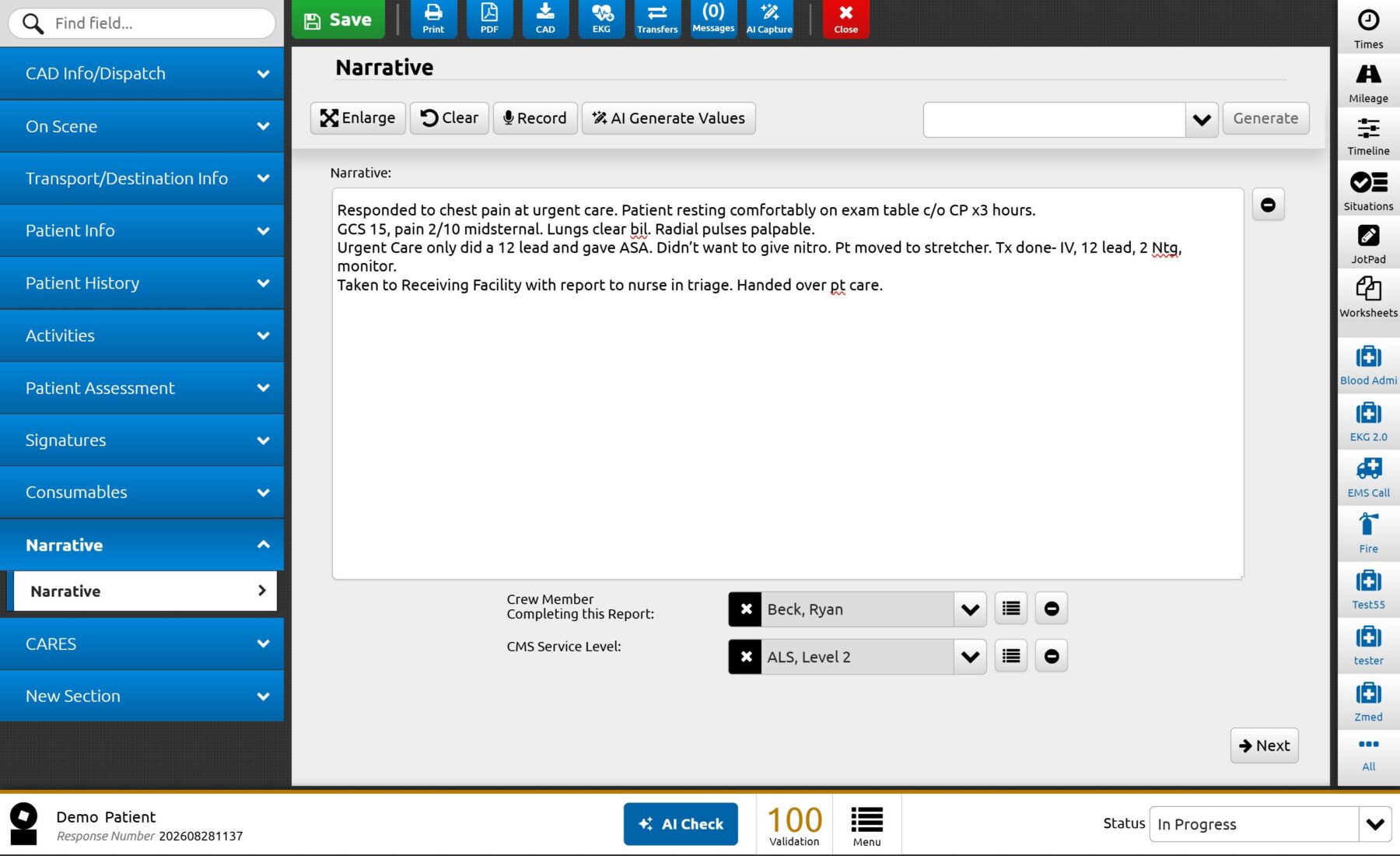
Chest Pain Narrative Example
What could be stronger
The narrative establishes the three-hour history of midsternal chest pain and notes a pain score, GCS, lung sounds, radial pulses, aspirin given before EMS arrival, and EMS interventions. However, it does not describe the pain’s onset, quality, radiation, or associated symptoms; provide vital-sign or 12-lead findings; clarify why nitroglycerin was initially withheld or later administered; or document the patient’s response to treatment and condition during transport.
Respiratory Narrative Example

What could be stronger
The narrative identifies shortness of breath lasting one week and records oxygen, vital signs, lung sounds, albuterol, transport, and a stable condition. Still, it leaves out the patient’s initial and repeat vital-sign values, oxygen saturation, work of breathing, oxygen delivery method and flow rate, albuterol dose and route, response to treatment, relevant history, and a more complete reassessment before transfer of care.
These examples are useful because weak documentation is not always inaccurate. It may simply be too incomplete or nonspecific to support the full clinical story, quality review, reimbursement, or future analysis.
Stronger Narrative Examples: Trauma and Pediatric Calls
The trauma and pediatric examples demonstrate how a more complete narrative gives reviewers a clear, chronological account of the encounter. The screenshots below show how specific observations, care decisions, and patient responses can strengthen the record.
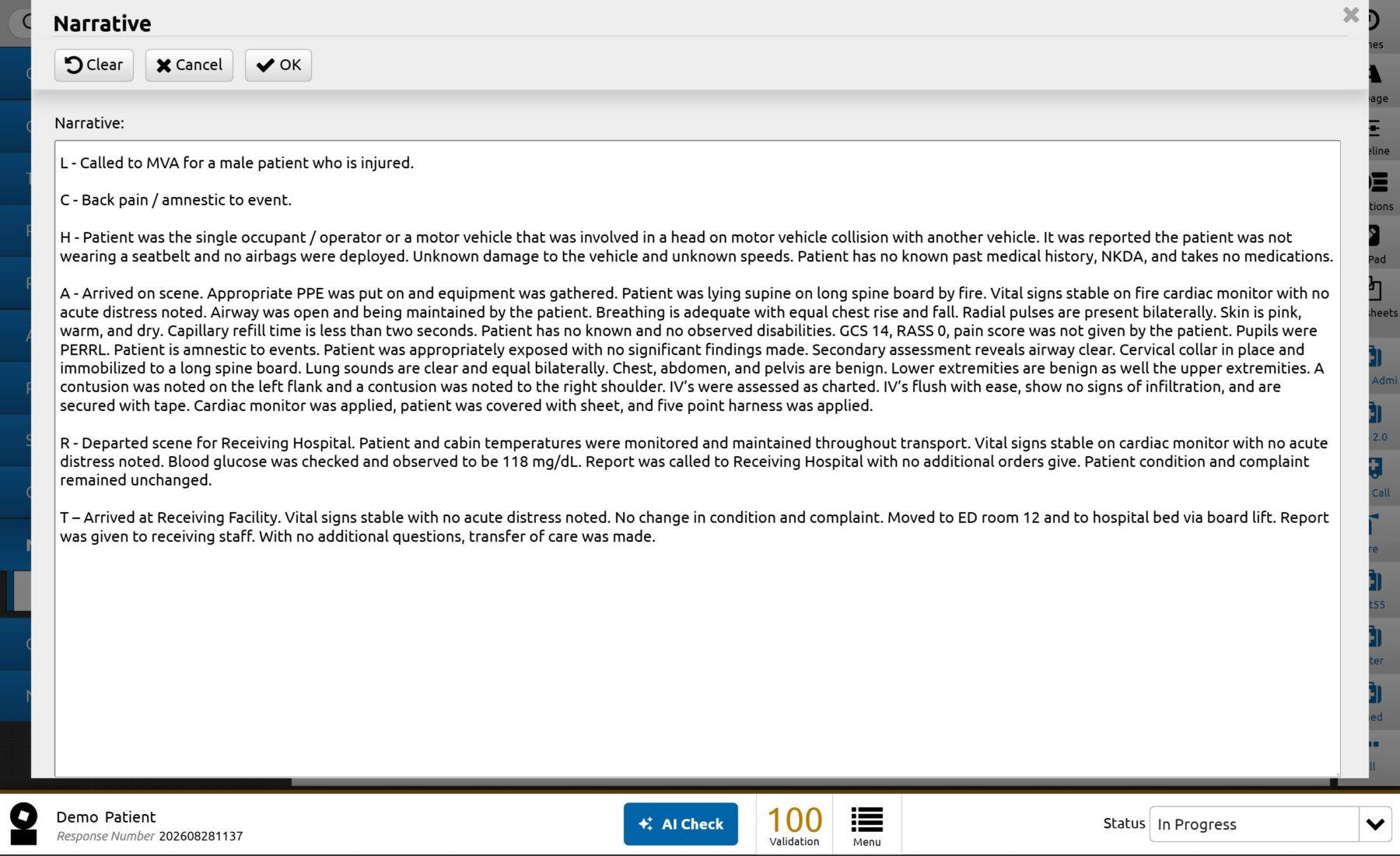
Adult Trauma Narrative Example
Why it works
The narrative follows a clear CHART structure and documents the collision details, lack of restraints and airbag deployment, back pain and amnesia, initial presentation, primary and secondary assessments, GCS, pupil findings, specific contusions, spinal precautions, IV assessment, monitoring, glucose result, transport reassessment, and transfer of care. That chronology gives the reader a detailed picture of the patient’s condition from scene arrival through handoff.
It also documents relevant negatives and repeat stability during transport rather than simply stating that the patient was transported. Those details support continuity of care and provide a defensible record of the crew’s assessment, immobilization, monitoring, and handoff.
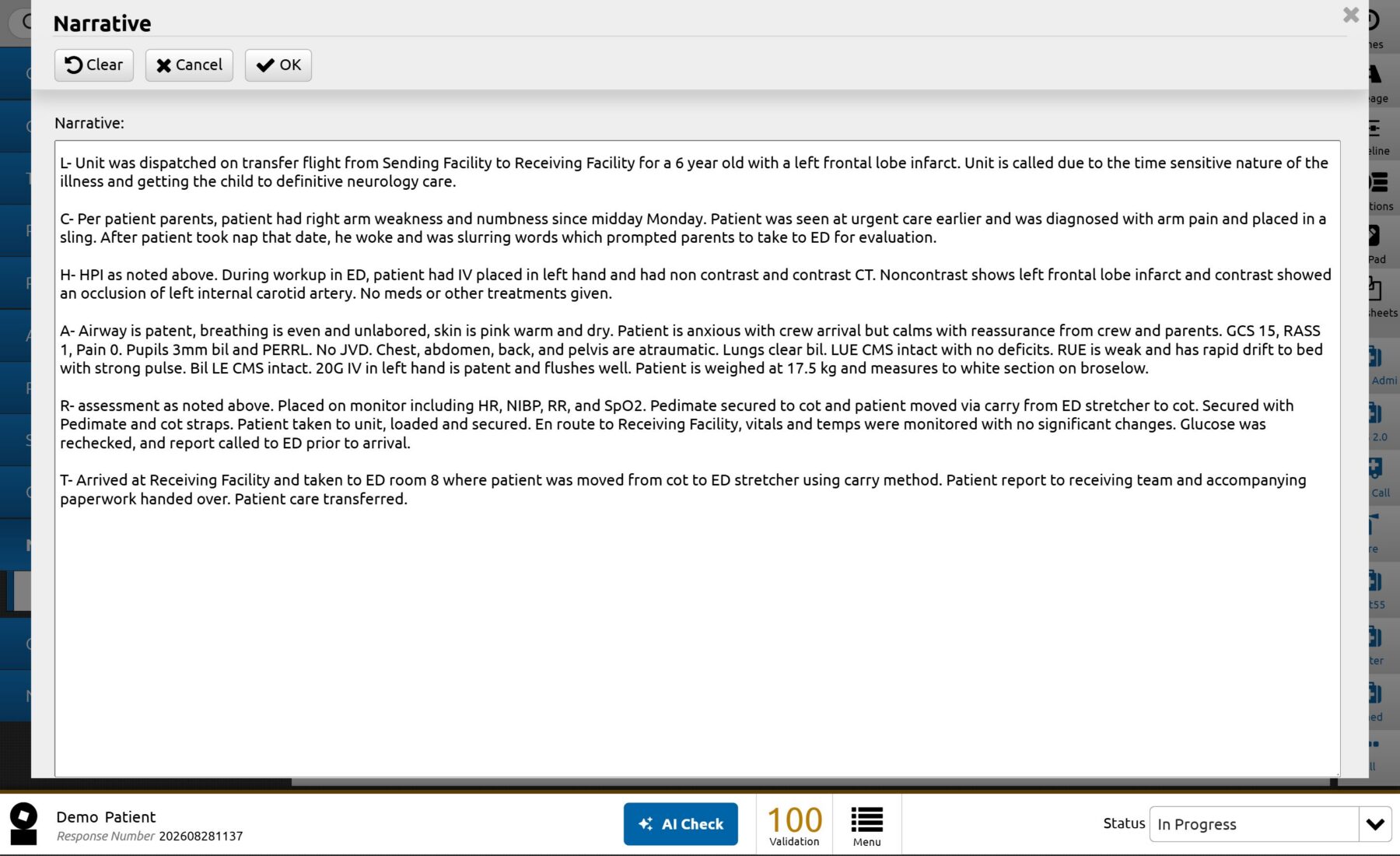
Pediatric Narrative Example
Why it works
The narrative explains why the six-year-old required a time-sensitive transfer, uses the parents’ history to establish symptom progression, summarizes the sending facility’s CT findings and treatment, and documents a detailed pediatric assessment. It includes neurologic findings, GCS, pupils, pain, weight, vascular access, monitoring, glucose recheck, transport stability, and communication with the receiving emergency department.
The account remains chronological through movement, securement, transport, arrival, and transfer of care. It gives the receiving team both the clinical reason for transfer and the child’s neurologic and overall status throughout the encounter.
Across both stronger examples, the value comes from specificity rather than length alone. The narrative connects findings, interventions, patient response, and disposition into one coherent account.
Details that often separate stronger narratives from weaker ones include:
- Time of symptom onset
- Patient quotes
- Mental status findings
- Response to treatment
- Clinical decision-making rationale
- Transfer of care information
When these details are omitted, the narrative may record that care occurred without fully showing why decisions were made, how the patient changed, or what downstream teams need to know.
How Patient Care Reports Drive Better EMS Decisions
Every patient care report begins as a single patient encounter. Over time, thousands of reports create a powerful source of operational and clinical insight.
Clinical Quality Improvement
Documentation helps agencies identify trends, monitor protocol compliance, and evaluate treatment effectiveness.
For example, cardiac PCRs can help determine whether aspirin administration rates meet established quality benchmarks.
Billing and Reimbursement
Documentation quality directly affects reimbursement outcomes. Missing patient information, incomplete assessments, or unclear medical necessity documentation can contribute to claim delays and denials.
Operational Planning
PCR data helps leaders understand:
- Call volume trends
- Geographic demand patterns
- Response performance
- Resource utilization
- Staffing needs
Hospital Collaboration and Outcomes
When EMS and hospital data are connected through Carelytics and other hospital interoperability solutions, agencies can gain greater visibility into patient outcomes and identify opportunities for improvement across the continuum of care.
How ePCR Software Helps EMS Teams Document Faster and More Accurately
Modern ePCR platforms help agencies improve both documentation quality and operational efficiency.
Benefits of ePCR software include:
- Standardized data collection
- Faster report completion
- Reduced documentation errors
- Improved compliance
- Better accessibility and record management
- Integration with external systems
Advanced ePCR solutions can also support information sharing between EMS agencies and healthcare organizations. Carelytics, for example, connects EMS and hospital data through automated ePCR delivery, patient and encounter matching, and bidirectional outcome sharing, helping reduce duplicate data entry and improve continuity of care.
As agencies continue to collect more data, the value of documentation extends beyond report completion. Quality ePCR data can support reporting, analytics, benchmarking, reimbursement workflows, and organizational decision-making.
Turning Documentation Into Actionable Insight
Strong patient care reports do more than document what happened during a call. They support patient care, strengthen compliance efforts, improve reimbursement accuracy, and create the data agencies need to evaluate performance and improve outcomes.
Whether you’re an EMT student learning documentation fundamentals or an EMS leader focused on quality improvement, investing in better PCR documentation pays dividends across the organization.
The most effective EMS agencies understand that every report contributes to a larger picture. Better documentation leads to better data. Better data helps drive better clinical, financial, and operational decisions.
Frequently Asked Questions About Patient Care Reports
What should be included in a patient care report?
A patient care report should include patient demographics, chief complaint, assessment findings, treatments provided, transport details, and a complete narrative describing the encounter.
What is a PCR narrative?
A PCR narrative is the written description of the patient encounter that provides clinical context beyond structured data fields.
What is the difference between a PCR and an ePCR?
A PCR refers to the patient care report itself. An ePCR is the electronic version completed using digital documentation software.
How long should a patient care report narrative be?
A narrative should be long enough to accurately document the encounter while remaining clear and concise. The focus should be on completeness rather than length.
What is the SOAP format in EMS documentation?
SOAP stands for Subjective, Objective, Assessment, and Plan. It is a structured approach commonly used for clinical documentation.
What is the CHART method in EMS documentation?
CHART stands for Chief Complaint, History, Assessment, Rx (Treatment), and Transport.
Why is documentation important for EMS reimbursement?
Complete and accurate documentation helps support medical necessity, validate treatments, and reduce the risk of reimbursement delays or denials.