Achieving a desirable fire department ISO rating lowers community insurance costs, but success depends on verifiable, audit-ready documentation from across your department’s operations. Discover how ImageTrend’s connected platform streamlines pre-incident planning, field inspections, fire RMS logging, and custom reporting to help your organization maximize its score.
Understanding Your Fire Department ISO Rating and How to Improve It
Every fire chief has felt the pressure of an upcoming Insurance Services Office (ISO) evaluation. Your community’s fire department ISO rating, officially called the Public Protection Classification (PPC®) score, is more than a badge of administrative honor. It directly impacts local commercial property owners, homeowners, and business investors. That ISO rating influences their municipal fire insurance rates.
A lower score on ISO’s 1-to-10 scale means the department has superior fire suppression capabilities, which can translate into substantial insurance savings across your district. However, securing a low ISO rating for your fire department requires more than operational dedication. It hinges on verifiable data transparency, operational readiness, and precise record-keeping across the entire operations lifecycle. If an activity isn’t documented, ISO auditors may consider it undone.
How ISO Evaluates a Fire Department ISO Rating
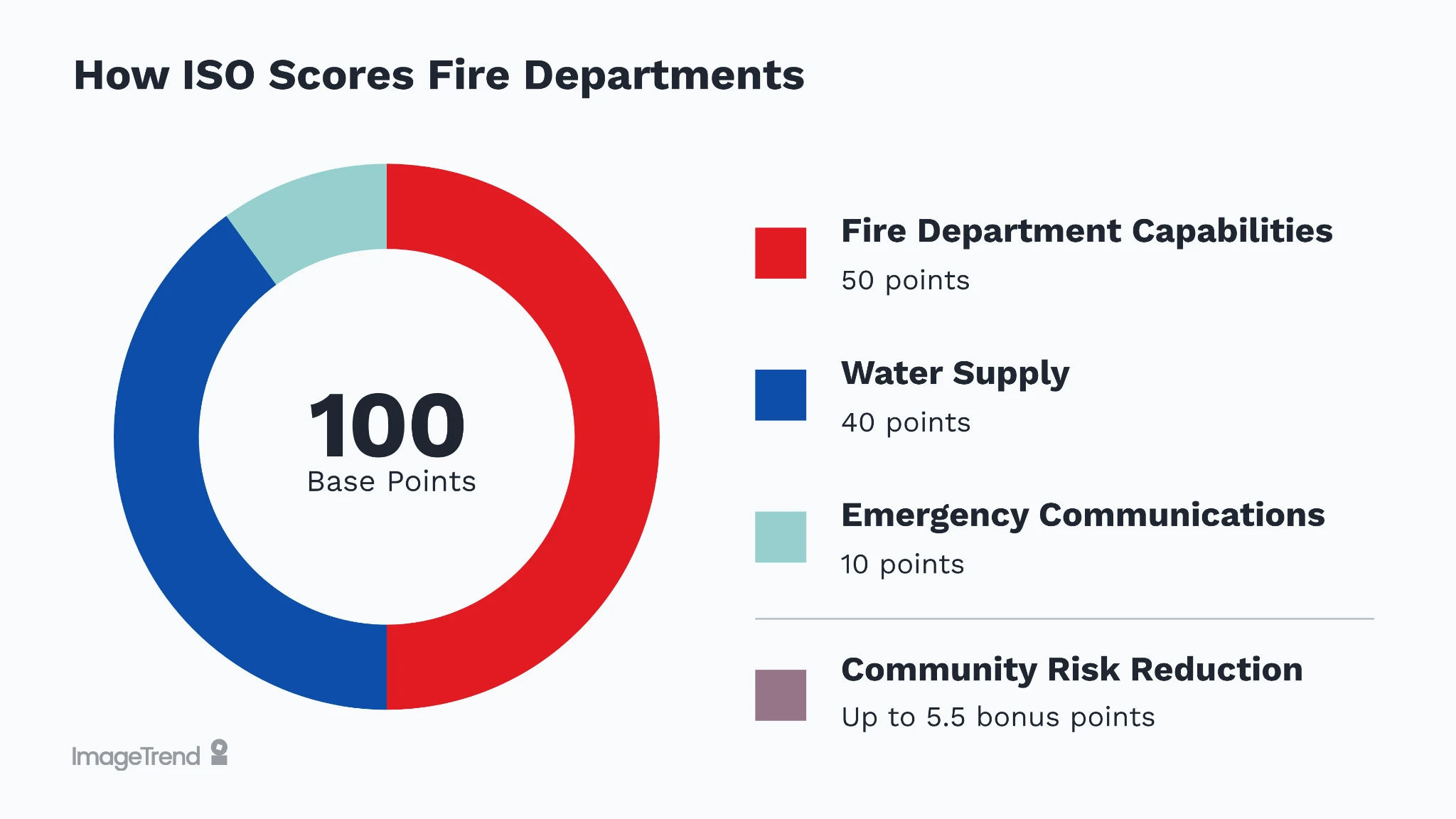
ISO auditors evaluate local fire protection using the Fire Suppression Rating Schedule (FSRS), assigning a cumulative score out of 100 possible points across four primary categories:
| Fire Department Capabilities (50 points) | Measures engine and ladder company distribution, apparatus maintenance, equipment inventories, minimum operational staffing, and verified training hours. |
| Water Supply (40 points) | Assesses local water distribution, inspection schedules, hydrant flow testing, and reliable alternative water supply operations. |
| Emergency Communications (10 points) | Evaluates call processing, dispatch efficiency, CAD system connectivity, and emergency communication capabilities. |
| Community Risk Reduction (up to a 5.5 points bonus) | Awards extra credit for proactive fire prevention programs, public education, commercial code enforcement, and fire investigation workflows. |
Navigating the specifics of this grading system requires accessible, organized data. Software systems designed specifically for emergency services ensure inspections, hose tests, and company training records are logged, organized, and audit-ready.
Improving Your ISO Score Across the Incident Lifecycle
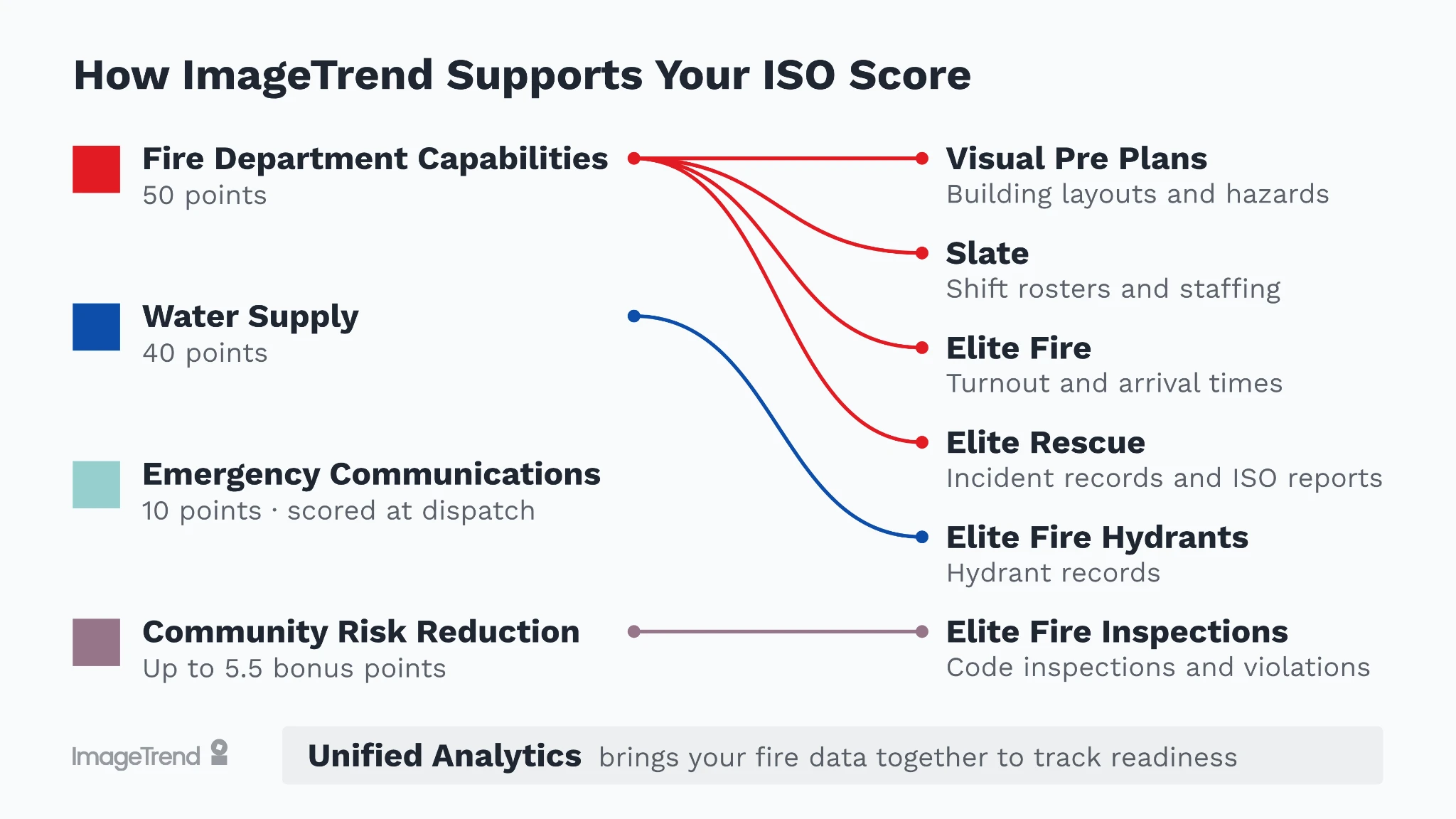
To maximize your department’s PPC score, your documentation strategy should support every phase of your emergency operations. ImageTrend’s connected suite of tools connects proactive prevention, active response tracking, and post-incident analytics into a unified compliance chain that can help improve your ISO score.
Pre-Incident Preparation & Prevention (Proactive Mitigation)
- Capturing Code Compliance and Hydrant Data with Fire Inspection and Permits SoftwareProactive risk reduction provides the foundation for community safety. ImageTrend’s Fire Inspection and Permits software allows inspectors and field crews to digitize commercial fire code enforcement, occupancy tracking, and permit workflows directly on mobile tablets.
In addition, field crews can log annual hydrant inspections, flow tests, and maintenance records in real time. This automated tracking helps score points in the Water Supply (40 points) and Community Risk Reduction (5.5 bonus points) categories without relying on paper logs. - Enhancing Target Hazard Preparedness with Visual Pre Plans
ISO auditors closely review an agency’s pre-incident planning coverage for commercial, industrial, and high-hazard structures. Visual Pre Plans assists crews in collecting spatial building layouts, utility shutoff locations, emergency key box placements, and hazardous material storage details before an incident occurs.Digitizing site assessments helps your agency meet ISO pre-plan coverage metrics while giving incident commanders immediate situational awareness on scene. - Verifying Roster Readiness and Shift Staffing with Slate
In the Fire Department Capabilities section of the audit, ISO evaluates daily minimum staffing levels on the department’s response vehicles. ImageTrend’s Slate simplifies workforce management by tracking daily shift rosters, call-backs, and minimum staffing thresholds in real time.A verifiable record of on-duty personnel per shift provides auditors with clear proof of operational readiness.
Incident Response & Real-Time Operations (Active Mitigation)
- Tracking Response Times and On-Scene Operations with Fire RMS SoftwareWhen an incident call comes in, capturing accurate operational benchmarks is critical. ImageTrend Elite’s Fire RMS Software accurately logs incident callouts, apparatus turnout times, arrival benchmarks, and on-scene personnel counts.Direct CAD integration automatically generates response timestamps, reducing manual data entry for firefighters while building a precise, verifiable timeline of emergency operations that meets ISO’s strict response capability metrics.
Post-Incident Review, Auditing & Analytics (Continuous Improvement)
- Simplifying Audit Preparation with EMS and Fire Reporting SoftwareGathering records ahead of an ISO evaluation used to mean spending hours, maybe days, sorting through a variety of spreadsheets and paper binders.Elite Rescue’s EMS and Fire Reporting Software removes this burden by letting administrators query historical incident logs, training records, vehicle maintenance histories, and inspection files from a single interface. Custom ISO reports can be generated in minutes, giving auditors quick access to training records, apparatus inventories, incident response data, and the other exact data points they need.
- Monitoring ISO Performance with Unified AnalyticsAchieving a great ISO rating shouldn’t be a last-minute scramble. Unified Analytics transforms incident logs, inspection records, and apparatus benchmarks into clear, real-time data insights.At any given time, department leaders can monitor key compliance metrics, such as average response times, missed inspection windows, or lagging training hours, in real time. This ongoing visibility helps fire chiefs identify potential readiness gaps, monitor operational performance, and address issues long before the ISO auditor arrives.
Aligning Practices, PPC Scores, and ImageTrend Software Resources
| Incident Lifecycle Phase | Recommended Operational Improvement | ISO PPC Category & Weight | Supporting ImageTrend Software |
| Pre-Incident Preparation & Prevention | Digitize commercial code enforcement, occupancy permits, and annual hydrant flow testing | Water Supply (40 points) & Community Risk Reduction (5.5 bonus points) | Fire Inspection & Permits |
| Pre-Incident Preparation & Prevention | Map hazards, structural layouts, utility shutoffs, and emergency entry box access | Fire Department: Pre-Fire Planning (within 50-point core) | Visual Pre Plans |
| Pre-Incident Preparation & Prevention | Enforce daily vehicle minimum staffing thresholds and verifiable shift rosters | Fire Department: Company Personnel & Staffing (within 50-point core) | Slate |
| Incident Response & Real-Time Operations | Capture CAD-integrated turnout benchmarks, travel intervals, and on-scene staff counts | Fire Department: Operational Capabilities & Response (within 50-point core) | Fire RMS |
| Post-Incident Review & Auditing | Centralize multi-year training logs, maintenance records, and run histories into instant query reports | Fire Department: Training, Maintenance & Records (within 50-point core) | Elite Rescue EMS & Fire Reporting |
| Post-Incident Review & Auditing | Track compliance trends, missed inspection windows, and turnout variances in real time | Continuous readiness across all scoring categories | Unified Analytics |
Point values represent category maximums. Individual activities contribute to specific scoring criteria within those categories
Best Practices for a Successful ISO Audit
In addition to leveraging ImageTrend software platforms, fire departments can streamline their next evaluation by adopting a few proactive administrative habits:
- Conduct Annual Internal Audits: Use custom reports to review and inventory your department’s data every 12 months to catch missing entries early.
- Log Training Hours Immediately: Ensure your company officers log daily drills, multi-agency exercises, and driver training right after completion to avoid overlooked or forgotten log entries.
- Maintain Hydrant and Hose Testing Schedules: Schedule routine annual testing and log flow rates directly into your RMS to protect your 40% Water Supply allocation.
Elevate Your Agency’s ISO Score
An improved fire department ISO rating protects your community, strengthens municipal infrastructure, and delivers tangible financial benefits to local property owners through lower insurance costs. However, securing the rating your agency deserves relies on accurate, accessible, and comprehensive documentation across every department workflow.
By integrating pre-incident planning, field inspections, fire operations, and custom reporting into a single platform, ImageTrend helps fire departments eliminate manual record-keeping burdens and face ISO audits with confidence.
Ready to streamline your ISO compliance and elevate agency performance?
Schedule a demo with ImageTrend today to see our solutions in action.