












The Challenge
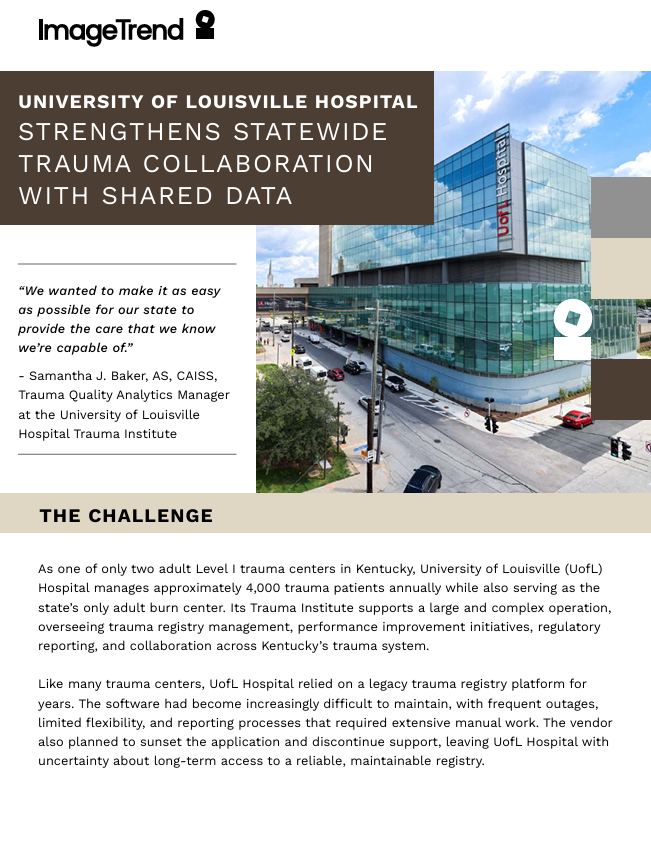
As one of only two adult Level I trauma centers in Kentucky, University of Louisville (UofL) Hospital manages approximately 4,000 trauma patients annually while also serving as the state’s only adult burn center. Its Trauma Institute supports a large and complex operation, overseeing trauma registry management, performance improvement initiatives, regulatory reporting, and collaboration across Kentucky’s trauma system.
Like many trauma centers, UofL Hospital relied on a legacy trauma registry platform for years. The software had become increasingly difficult to maintain, with frequent outages, limited flexibility, and reporting processes that required extensive manual work. The vendor also planned to sunset the application and discontinue support, leaving UofL Hospital with uncertainty about long-term access to a reliable, maintainable registry.
The issue extended beyond UofL Hospital. Other Kentucky facilities used aging registry platforms, while smaller community and rural hospitals often lacked the budget for new technology. Because designated trauma centers must maintain a registry and submit data to the statewide Kentucky Trauma Data Bank each quarter, these technology and cost barriers could limit participation in the state trauma system.
For community hospitals pursuing trauma designation, the cost of registry technology created another significant barrier. With healthcare expenses rising and budgets tightening, many rural and smaller facilities struggled to justify the investment required to participate in a formal trauma system. That challenge shaped UofL’s broader goal for the project. “We wanted to make it as easy as possible for our state to provide the care that we know we’re capable of,” said Samantha J. Baker, AS, CAISS, Trauma Quality Analytics Manager at the University of Louisville Hospital Trauma Institute.
The Solution
UofL Hospital needed more than a replacement for its registry system. It needed a modern, reliable platform that could simplify complex trauma data workflows and support the organization’s broader vision for registry operations. To meet those needs, UofL Hospital selected ImageTrend Patient Registry, a platform for collecting, managing, analyzing, and reporting trauma, burn, stroke, and cardiac registry data.
The organization also took a unique statewide approach. Under the leadership of its executive team, UofL expanded access to Patient Registry by providing direct-entry access for Level III, Level IV, and developing trauma centers throughout Kentucky at no cost.
This initiative created a shared platform where facilities across the state could collect standardized data, collaborate more effectively, and gain access to tools that may otherwise have been financially out of reach. By bringing 33 participating facilities onto UofL Hospital’s shared Patient Registry instance, the programs could align around consistent reporting, performance improvement efforts, and data collection practices.
The Outcome
Since implementing ImageTrend Patient Registry, UofL Hospital has transformed both internal registry operations and statewide trauma collaboration. What began as a software migration evolved into a foundation for improving consistency, communication, and performance improvement efforts across Kentucky’s trauma system.
More Time for Strategic Work
By reducing manual reporting, validation, and data cleanup, Patient Registry has given staff more time for higher-value work such as trend analysis, education, and quality improvement. One major reporting and data preparation workflow has been reduced from approximately two full business days to just one, cutting the effort by roughly 50%. “I have time on my hands to look for new trends, identify a cool project we can do with our data, educate my team,” Baker said, underscoring the team’s expanded capacity for proactive, strategic work.
Strengthened Statewide Collaboration
By providing shared access to Patient Registry, UofL has helped create a more connected trauma community throughout Kentucky. New and developing trauma centers now have access to experienced peers, standardized data collection, and ongoing collaboration opportunities that support long-term success.
The shared platform has also aligned trauma centers, burn programs, and EMS stakeholders around common data and reporting practices, creating a more unified statewide approach to trauma care. As Baker explained, “We’re all finally getting into the same place, doing the same things with the same data.”
Greater Visibility in Performance Improvement
Patient Registry’s reporting capabilities and real-time dashboards have enhanced UofL’s ability to identify, monitor, and address performance improvement opportunities. By shifting key reviews earlier in the workflow, staff can access data sooner and identify issues more quickly.
Trauma analysts also play a more active role in performance improvement by reviewing key events before data leaves the registry, strengthening the organization’s culture of continuous improvement.
The Results
Metric | Before Patient Registry | After Patient Registry |
Time required for reporting and data preparation | Approximately 2 full business days per reporting cycle | Approximately 1 business day, reducing effort by roughly 50% |
Kentucky hospitals participating in shared registry environment | Disconnected systems across the state with varying registry solutions | 33 facilities onboarded to a shared Patient Registry instance |
Statewide user community | Limited collaboration between facilities | Approximately 150-175 active users collaborating on a common platform |
NTDB/TQIP reporting workflow | 5-step process requiring exports, third-party tools, validation fixes, and multiple submissions | Simplified workflow with direct export capabilities and integrated validation checks |
Recurring operational reporting | Manual report generation and tracking requirements | Automated scheduled reports delivered automatically to stakeholders |
Access to real-time operational insights | Limited visibility requiring manual reporting and analysis | Real-time dashboards providing immediate visibility into key trauma metrics |
Access for smaller and developing trauma centers | Registry software costs created barriers to participation | No-cost direct-entry access for participating Level III, Level IV, and developing centers |
Looking Ahead
UofL Hospital’s vision extends well beyond its own trauma program. By creating a shared Patient Registry environment for trauma centers across Kentucky, the organization has helped establish a foundation for stronger statewide collaboration, standardized data collection, and continuous performance improvement. As more facilities adopt common processes and reporting practices, trauma leaders can focus less on managing disparate systems and more on improving patient outcomes.
The team also sees opportunities to expand how registry data is used within individual programs. As clinicians, trauma leaders, and performance improvement teams become more engaged with real-time data and reporting tools, UofL Hospital expects to further strengthen its ability to identify trends, support evidence-based decision-making, and drive quality improvement initiatives.
For Samantha Baker, one of the most exciting aspects of the journey is knowing that both established and emerging trauma centers now have access to the same foundation for success. With more organizations aligned on a common platform, Kentucky is continuing to build a more connected trauma system where data, collaboration, and shared learning can support better care across the state.
Learn more about how ImageTrend Patient Registry can simplify registry data collection, reporting, validation, and performance improvement. Explore Patient Registry.

Related Resources


Tomorrow Won’t Look Like Today. Prepare for What’s Next.
See the bigger picture and confidently face the challenges ahead with our industry-leading solutions.